

Beschreibung
Erhaltung: ss+ / ss | Abkürzungen
Katalognummer: Warendorf
Durchmesser: 20,00 mm
weight 2,24gr. | copper Ø 20mm.
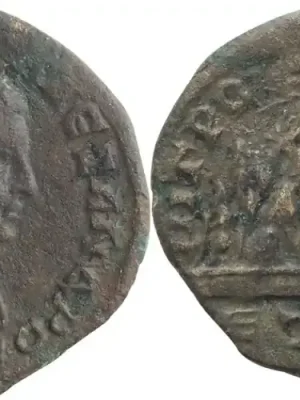
obv. Standing figure of St. Lawrence holding palm branch,
city arms to right, withing circle surrounded by the legend
MOCIVITAWARENDOR
rev. Value III, 1690 below, between two branches with leaves that
are connected at the top and bottom with ribbons to form a wreath
Warendorf is a town in North Rhine-Westphalia. The origin and name Warendorf date back to the ancient Saxon royal court of Warintharpa (the village on the embankment), which was most likely already formed in 700 AD. Between the years of 1197 and 1201 Warendorf became a town. During this time, among the already established parish, which belonged to the old church (St. Laurentius), a new, second parish with the new church (Marienkirche) was formed just west of the town centre. The medieval records of the founding of Warendorf are missing, along with several records and documents in Münster. These were all destroyed during the rule under the Anabaptists. Bishop Hermann II von Katzenelnbogen (Bishop 11731202) also contributed to the founding of the town. In 1224 the first recorded mention of Warendorf as a civitas, which is a civil and municipal community, was made. The wealth of Warendorf grew increasingly and developed more and more into an important trading town, since it is situated favourably between Münster and Oelde. Apart from that Warendorf profited from the production and selling of linen. The wealthy citizens settled on the market square and in the streets, Emsstrasse and Oststrasse. Still today these areas of the town are most prominent in the townscape of Warendorf. In contrast, the poorer part of population lived in simple houses with dirt floors. These bad living conditions lead to the epidemics and illnesses. In 1404 there was a great fire in Warendorf, during which along with 600 houses also the old church (St. Laurentius) and the town hall with all its inventory were destroyed. In 1533 the Anabaptist movement spread in Warendorf and also in Münster. This movement took over rule in the town for one week in October 1534, until it was ended by a short occupation by Bishop Franz von Waldeck. Four Anabaptist apostles and the Warendorf Anabaptist movement leaders were sentenced to death and were executed by a sword on the market square. As a deterrent the bodies of the apostles were laid on the four gates into the town. As a result of this, Warendorf lost its town rights and regained them again in 1542. Free elections of the local council were first held in 1556 under Bishop Franz von Waldecks successor. The Anabaptist movement continued up into the 17th century in the background without any serious danger for the town or church. Between 1627 and 1632 loss of the town rights occurred during religious battles of the Thirty Years War. The first mention of the Fettmarkt dates back to 1657. This event remained an important funfair with a flea market and livestock market still today. In 1741 another great fire broke out, which resulted in the destruction of the new church (Marienkirche) and 332 houses. Because many tradesmen had to move further, and so Warendorf suffered economic loss. In 1802 Warendorf came under the Prussian sovereignty. KM.34 | Weingärtner 261d | de Mey 16 | Numista 310683
Very attractive for the type. Rare.
vf+/vf